

How your return is calculated
Metrifly works out your return with the industry-standard money-weighted method (a variation of Modified Dietz) that accounts for how much you invested and when. This explains, in plain English, how the headline return on your portfolio dashboard is put together.
The short version
Section titled “The short version”Your total return is the sum of three things — price movement, income, and currency — measured against what you actually paid (your cost basis), then expressed as a per-year figure. That’s it. The rest of this page unpacks each part with worked examples.
Your return has three parts
Section titled “Your return has three parts”Metrifly always splits your total return into three sources, which add up to the total:
| Part | What it is |
|---|---|
| Capital gain | The change in the price of your holdings (both what you still hold and what you’ve sold) |
| Income | Dividends and distributions you’ve received, grossed up to include franking credits |
| Currency gain | For overseas holdings, the part of the gain caused by the exchange rate moving |
Total return = Capital gain + Income + Currency gainFor an Australian-dollar holding, the currency part is always zero. For a US stock, your gain is split between how much the share price moved and how much the AUD/USD rate moved.
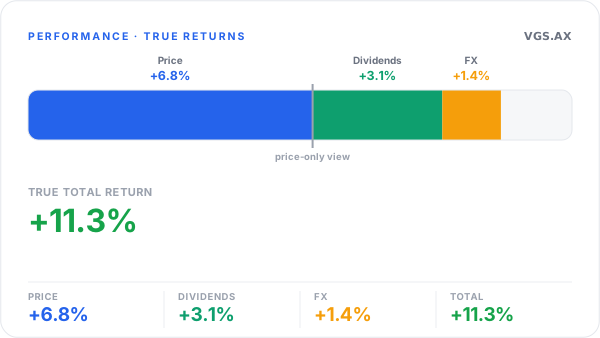
Your true return is price plus dividends plus currency — not price movement alone.
What counts as “what you invested”
Section titled “What counts as “what you invested””Your return percentage is measured against the total amount you paid for your shares — your cost basis. This includes brokerage: a $5,000 purchase with $20 of brokerage has a cost basis of $5,020.
Importantly, your cost basis does not shrink when you sell. If you bought $10,000 of a stock and later sold half, your return is still measured against the full $10,000 you originally invested. The profit on the shares you sold stays in your return as a realised gain.
How the percentage is worked out
Section titled “How the percentage is worked out”Metrifly turns your dollar return into a percentage, then into a per-year (annualised) figure, so you can fairly compare holdings held for different lengths of time.
Total return % = Total return ($) ÷ What you investedAnnual return % = Total return % ÷ Average years investedAverage years invested is the heart of the method. Each purchase is weighted by how long that money was actually invested — money you added recently counts for less time than money invested years ago.
Worked example
Section titled “Worked example”You buy a stock twice, then sell the lot:
| Action | Amount | Held for |
|---|---|---|
| Buy | $2,000 | 2 years |
| Buy | $2,200 | 1 year |
| Sell everything for | $4,600 | — |
- Total return = $4,600 − $4,200 = $400
- What you invested = $2,000 + $2,200 = $4,200
- Average years invested = (2,000 × 2 + 2,200 × 1) ÷ 4,200 = 1.48 years
- Total return % = 400 ÷ 4,200 = 9.5%
- Annual return = 9.5% ÷ 1.48 = 6.5% per year
Simple vs compound
Section titled “Simple vs compound”You can choose how the per-year figure is calculated, in your performance settings:
- Simple — divides the total return evenly across the years (the example above, 6.5%).
- Compound (CAGR) — the steady year-on-year growth rate that produces the same result, slightly lower because it accounts for compounding.
Holdings you’ve owned for less than a year
Section titled “Holdings you’ve owned for less than a year”For a holding owned for under one year, Metrifly shows your total return for the period rather than stretching it into a per-year figure. A 5% gain over one month is a real 5%, not “about 80% per year.” Once a holding passes a year, the annualised figure kicks in.
Foreign holdings and currency
Section titled “Foreign holdings and currency”For a holding priced in another currency, your gain splits into two:
- Capital gain — how much came from the share price moving, and
- Currency gain — how much came from the exchange rate moving between when you bought and now.
Example. You buy a US stock for US$1,000 when A$1 buys US$0.70 (about A$1,429). Later it’s worth US$1,200, but the Australian dollar has strengthened to US$0.80 (so US$1,200 is now about A$1,500). Your A$71 total gain is the net of a +A$250 share-price gain and a −A$179 currency loss (the stronger Aussie dollar working against your US holding).
Income and franking credits
Section titled “Income and franking credits”Dividends and distributions count toward your income return, converted to your portfolio currency using the exchange rate on the payment date. For Australian shares, Metrifly grosses up franked dividends to include franking credits, matching how your income is reported for tax.
Example. A $400 fully-franked dividend carries about $171 of franking credits, so your income is recorded as $571. See Track your dividends for more.
Why this might differ from your broker app
Section titled “Why this might differ from your broker app”Broker apps usually show a simpler “price went up X%” figure, so Metrifly’s fuller number will often differ. For the full list of reasons and what to check, see Why your return is different from your broker app.
Related articles
Section titled “Related articles”- See how your portfolio is performing — TWR, money-weighted return, drawdown, and Sharpe
- Why your return is different from your broker app
- Get ready for tax — capital gains, the CGT discount, and franking